
Improving your golf game isn't just about spending more time on the course or hitting more balls at the range. A good golf training plan helps you train with a clear purpose, focus on your weaknesses, and measure your progress.
Whether you're trying to lower your handicap or prepare for competition, a structured plan can make your practice sessions much more effective.
What is a golf training plan?
A golf training plan is a structured way of organizing your practice around specific goals. Instead of arriving at the range and deciding what to work on, you know what you want to improve, how you're going to train, and how you'll measure your progress.
A good plan should include:
- Clear performance goals
- Your main areas for improvement
- A realistic weekly schedule
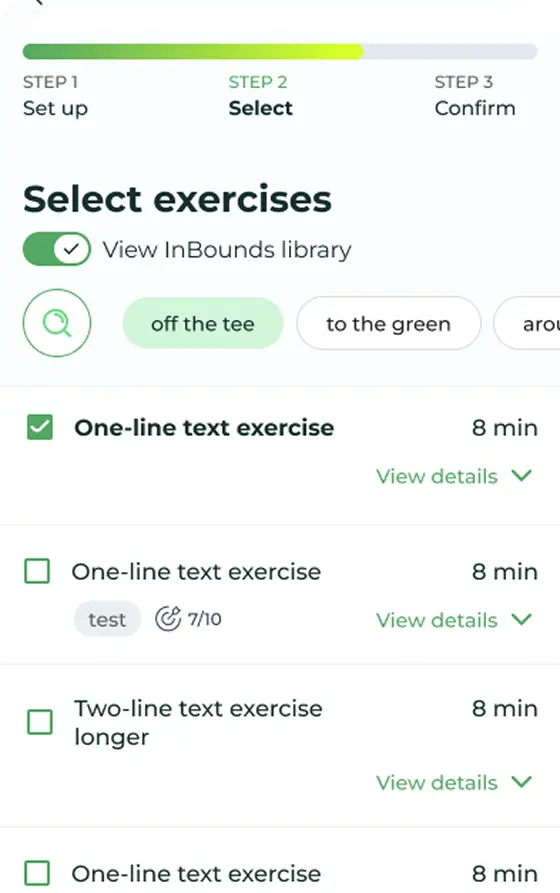
- Specific practice exercises
- Performance metrics
- Regular reviews
1. Start by identifying your weaknesses
Before creating your plan, look at your recent performance.
Your score is important, but it doesn't tell the whole story. Golf statistics such as Greens in Regulation (GIR), fairways hit, putts per round, scrambling, or penalty shots can help you understand where you're losing strokes.
For example, if your GIR is consistently low, your approach game may need more attention. If you're hitting enough greens but taking too many putts, putting could be a better priority.
Use your data to decide what to train.
2. Set specific goals
Once you know your weaknesses, turn them into measurable goals.
Instead of:
Try:
Specific goals make it easier to build relevant training sessions and evaluate whether your work is actually producing results.
3. Divide your training into key areas
A balanced golf training plan can include:
- Driving: accuracy, distance, and consistency.
- Approach shots: distance control, direction, and club selection.
- Short game: chipping, pitching, bunker shots, and scrambling.
- Putting: distance control, start line, and short-putt consistency.
- Course management: target selection, risk management, and decision-making.
You don't need to spend the same amount of time on every area. Prioritize the areas where your data shows the biggest opportunity for improvement.
4. Create a realistic weekly schedule
Your training plan needs to fit your actual schedule. For example:
| Session | Focus |
|---|---|
| Session 1 | Driving + long game |
| Session 2 | Short game + putting |
| Session 3 | Approach shots |
| Round | Apply your training on the course |
You don't need to practice every day. Consistency is more important than volume.
A focused 60-minute session with a clear objective can be more valuable than two hours of unfocused practice.
5. Track your progress
A training plan only works if you know whether you're improving.
Track relevant metrics during your rounds and practice sessions. Over time, you can identify trends and understand whether your training is having an impact. For example:
- Is your GIR improving?
- Are you reducing three-putts?
- Are you becoming more accurate off the tee?
- Are you making fewer mistakes around the green?
This turns your training into a continuous process:
6. Adjust your plan
Your golf training plan shouldn't stay the same forever.
Review your performance regularly and change your priorities as your game develops. Once one area improves, you can dedicate more time to another weakness.
The best training plans are flexible and based on real performance data.
Final thoughts
Building an effective golf training plan doesn't have to be complicated. Start by identifying your weaknesses, set measurable goals, organize your practice, and track your progress.
Most importantly, don't just practice more — practice with a purpose.
When you understand your performance data, you can make better decisions about what to work on and spend your training time where it can have the greatest impact.
Inbounds helps players and coaches turn golf performance data into smarter training decisions, making it easier to understand progress and focus on what really matters.
Build your training plan around real data
Log your rounds, track your stats, and know exactly what to work on next.
Discover Inbounds for players and start training with your data
How to Analyse Shot Dispersion to Improve Your Golf Decisions
Every golfer has a shot pattern. The question is whether they understand it well enough to make better decisions on the course.
You might have a player who tends to miss right with a mid-iron, or a driver pattern that spreads further than they realise. These tendencies can be easy to overlook when you focus on individual shots or judge performance by the final score alone.

How to Identify Performance Trends in Your Golf Players
You probably know your players pretty well.
You know who tends to struggle with their driver, who gets uncomfortable from 100 yards, who starts pressing after a bad hole and who tends to play better when the pressure is on.

A Week at the Open de España 2026: Precision, Adaptability, and Performance Data
The Open de España 2026, held from October 8th to 11th at Real Club de Campo Villa de Madrid, delivered four days of competitive golf shaped by changing course conditions, strategic decision-making, and a dramatic finish. After several days of rain leading into the tournament, players faced a course that evolved throughout the week, requiring constant adjustments from tee to green
