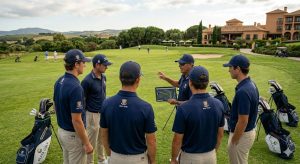
Planning a good golf training session is much more than picking a handful of drills and spending an hour on them. An effective session needs a clear objective, has to be tailored to the player's needs, and should let you check whether the work is actually producing results.
For coaches, having a training structure makes decision-making easier and helps get more out of every session. And when planning is backed by data, it becomes possible to pinpoint more precisely what each player needs to improve and track their progress over time.
In this article, we walk through how to plan a golf training session step by step.
1. Define the objective of the session
The first step is knowing exactly what you want to work on.
A goal that's too broad, like "improve the game," doesn't give you enough to design a session. Goals like "improve wedge distance control" or "increase accuracy off the tee," on the other hand, let you choose specific drills and metrics.
The objective can relate to different areas of the game:
Long game and accuracy off the tee.
Irons and approach shots.
Distance control.
Short game.
Putting.
Decision-making.
Preparation for a specific competition.
The key is that every session has a defined purpose, and that the drills are connected to that purpose.
2. Analyze the player's data
Before you start training, review how the player has been playing.
Golf statistics can help you spot patterns that aren't always obvious during a session. For example, a player might feel like their problem is the swing, when their data shows they're actually losing more strokes at certain distances or around the green.
Some useful metrics include:
Fairways hit: to analyze accuracy off the tee.
GIR (Greens in Regulation): to evaluate approach-shot performance.
Putts: to analyze performance on the green.
Up & downs: to assess the short game around the green.
Distance and dispersion: to understand shot consistency.
This data helps answer one fundamental question:
What does this player actually need to work on?
From there, the coach can design a more specific, personalized session.
3. Structure the training session
Once the objective is defined, organize the session into different blocks.
There's no single structure that works for every player, but a session can be broken down into:
Warm-up
Start with mobility drills and progressive swings to prepare the player. The goal is to gradually move from simple movements to shots closer to training intensity.
Technical work
Dedicate part of the session to the technical aspect you want to improve. At this stage, the player needs to understand what they're trying to change and practice it in a controlled way.
Specific drills
Once the technical aspect has been worked on, use drills specifically designed for the session's objective.
For example, if you want to improve wedge distance control, you can set different target distances and record where each shot finishes relative to the target.
Game situations
Finally, bring the drill closer to a situation the player will actually face on the course.
This is where you can introduce decision-making, specific targets, or different difficulty levels.
4. Adapt the drills to the player
A good golf training session shouldn't look exactly the same for every player.
Skill level, experience, error patterns, and individual goals can make the same drill work well for one player and add little value for another.
That's why, during the session, it's important to watch how the player responds and adjust the training when needed.
If a drill turns out to be too easy, you can increase the difficulty. If the player struggles to execute it, you can simplify it and build back up afterward.
Planning should act as a guide, not as a rigid structure that has to be completed at any cost.
5. Introduce pressure and real situations
Practicing a shot in controlled conditions is useful for developing a skill, but the player will have to execute it in far less predictable situations once they're on the course.
That's why part of the session should progressively move closer to real playing conditions.
You can set up challenges like:
Hitting a target within a limited number of attempts.
Choosing between different shot options.
Playing a specific on-course situation.
Setting accuracy targets.
Introducing pressure or scoring.
This way, the player isn't just practicing how to hit a shot, but also how to make decisions and respond to different situations.
6. Define what you're going to measure
Not everything that happens during a session needs to become a statistic. Still, choosing a few concrete metrics makes it easier to evaluate the training.
For example:
Objective
What you can measure
Accuracy off the tee
Fairways hit
Approach shots
GIR, proximity to target
Distance control
Distance relative to target
Short game
Up & downs
Putting
Putts and make percentage
What matters is setting the metric before the session starts.
That way, once it's over, you can compare the result with previous sessions and check whether there's been any progress.
7. Log what happens during training
The information from one session can be extremely useful for planning the next ones.
Recording what was worked on, which drills were used, and how the player responded lets you build a training history.
Over time, that history helps the coach spot trends:
Is the player improving?
Which drills are producing the best results?
Which aspects are still a problem?
What should be worked on in the next session?
This way, every session feeds information into better decisions for the next one.
8. Check whether the training transfers to the course
One of the most important parts of training is checking whether what improves during practice also improves during rounds.
A player can get great results on a specific drill and still fail to carry that over into a real playing situation.
That's why, whenever possible, compare the training data with on-course performance.
If the player has been working on iron accuracy, for example, you can check whether their GIR improves afterward. If they've been working on the short game, you can look at whether their up & downs increase during rounds.
This comparison shows you whether the training is having a real impact on performance.
9. End the session with a next step
A session shouldn't simply end once the allotted training time is up.
Spend a few minutes reviewing what was worked on, what results were achieved, and what should keep being practiced.
You can sum it up in three questions:
What have we worked on?
Key takeaways from the session?
What’s our next goal?
The answers will help shape the next session and maintain a logical progression in training.
The answers will help shape the next session and maintain a logical progression in training.
Data-driven golf training
Good planning makes every minute of training count toward a purpose. Setting objectives, analyzing the player's stats, choosing specific drills, measuring results, and checking their transfer to the course creates a far more structured process for improvement.
With Inbounds, coaches can plan and log training sessions, track their players' work, and use their data to better understand their progress.
Because coaching better doesn't just mean practicing more. It means knowing what to work on, measuring what happens, and using that information to decide what to do next.
Plan your sessions with real data
Log your players' training and track their progress with Inbounds.
Improving your golf swing doesn’t mean making every shot exactly the same. Even the best players have small variations from one swing to the next. The key is finding a movement, a contact, and a trajectory you can repeat often enough to trust it out on the course.
Data-driven golf training means using objective performance data to inform training and player development.
It doesn’t mean replacing coaching experience with numbers. A coach still needs to consider technique, course management, confidence, playing conditions and the individual characteristics of the player.
Michael La Sasso’s first professional victory came at one of the most important moments of the 2026 LIV Golf season. At just 22 years old, the former Ole Miss standout won LIV Golf Indianapolis at The Club at Chatham Hills, finishing at 18-under par and one shot ahead of Jon Rahm. The victory made La Sasso the youngest winner in LIV Golf history and capped a remarkable transition from NCAA champion to professional winner.
We use cookies to personalize content, provide social media features, and analyze our traffic. We also share information about your use of our site with our analytics partners. You can change your preferences at any time. For more information, please see our Privacy Policy and Cookie Policy. Privacy PolicyCookie Policy