
- Golf Events
A week at the 2025 Spain Open: When precision was everything
The Spain Open 2025 It was held from October 9 to 12 at the Villa de Madrid field club, and from the first day it was clear that it would be a true precision test. What we witnessed during those four days was not just another event of the DP World Tour, but one of the most technically demanding golf tournaments in Spain in recent times.
The preparation of the field was as hard as we have seen in recent editions: Fairways tight and firm, Rough dense and Greens Fast with subtle falls that challenged even the best kickers. Conditions were fair, but completely relentless. If you didn’t have full control from the tee, you were immediately forced to tow for the rest of the hole.

Technology joins the strategy in golf:
One of the most interesting aspects of Golf Open of Spain 2025 It was to observe how technology and analytics are becoming a real part of modern training.
Several coaches and players were actively following real-time performance metrics—monitoring Strokes Gained, the precision in Fairway, the proximity to the hole and the trends of Putting directly from the field. It was encouraging to see that some of them were using inbounds To collect and interpret these data live, using the information to adapt the strategy and understand exactly where the blows were won or lost.
Seeing the data applied in this way—not as simple numbers on a screen, but as a tool for decision making and communication—was a reminder of how much the game is evolving. For us, it was a moment of pride to realize that the same tools designed to help trainers and academies improve performance were now being used at such a high level of competition.
Precision above power: what defined the Spanish Open 2025
What stood out the most, however, was how small mistakes quickly turned into lost blows. an exit blow that failed the Fairway For just a few meters often meant a ball buried in Rough deep, no angle to the green and without the possibility of being aggressive. Recovery options were limited — you had to play smart, safely and, when the opportunity came, execute perfectly.
For the weekend, only the most disciplined players were still in the fight. As we follow the final groups on Saturday and Sunday, it became clear that this was not about who could do the lowest result. He went from who could avoid mistakes, manage his game patiently and make fewer mistakes than the rest of the field.
Our Vision: A Demanding Precision Test
From our perspective touring the field, the Villa de Campo de Madrid was a true test of control and discipline —much more than pure power. Fail Fairways It was punished, not only in theory, but in a measurable and statistical way throughout the Spain Open 2025.
We look at various coaches and caddies leaning more than ever on performance and analytics data. Tablets were used daily to review the dispersion of blows, data from Strokes Gained, proximity statistics and maps Putting. Players and teams clearly applied a more detailed strategy—adjusting in real time based on live metrics.
But no volume of data could save you if you didn’t hit the Fairways. The Rough It was thick, unpredictable and strategically placed to penalize even the smallest mistakes. fail the Fairway He often involved playing defensively—letting her short, pulling the ball sideways, or hitting bass simply to reposition herself.
Statistically, the players who failed the Fairway lost between 0.3 and 0.5 strokes per hole, according to the data we reviewed during the Golf Open of Spain 2025. The accumulated effect was enormous: the rhythm was lost, the inertia was broken and the confidence was put to the test.
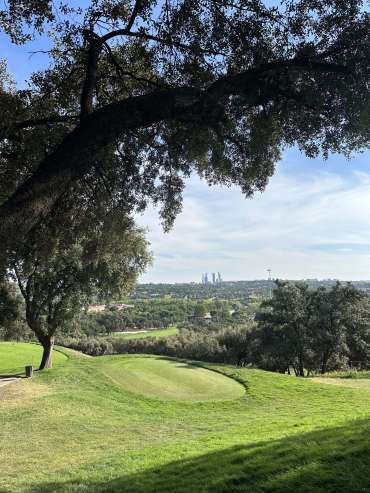
Field configuration: demanding, narrow and fair
How the field was played: from tee to green
Every hit from the tee mattered. the design of the Spanish Open 2025 It did not allow players to master it with power. As soon as you failed a Fairway, the angles disappeared, the lines of sight narrowed, and the Greens highs made the approach blows almost impossible.
the players who found Fairways They kept the rhythm and attacked the flags with confidence. Those who didn’t, had to fight to make the pair, both mentally and physically. Throughout more than 7,150 yards, the Villa de Madrid Field Club required patience, control and discipline.
Villa de Madrid Country Club
The biggest conclusion? This was not a field that could be mastered with power or tactically surpassed only. It demanded intelligent decisions, conservative objectives and total control of the pace and trajectory. Precision was everything.
The best rounds—such as Marco Penge’s winning performance—came from players who respected the field, played within their limits, and trusted their strategy.
From the initial round, the Villa de Campo de Madrid made it clear that he was not going to give low results. The design is traditional, but the combination of preparation, conditions and game strategy made it one of the most complete tests we’ve seen in a long time.
Every blow failed—especially from the tee—had a high cost. The Rough It was denser than usual and the Fairways They were firm and fast. A deviated drive only a few meters away used to involve losing control of the effect, launch, or the shape of the next hit.
Precision from the tee: generalized descent in the field
The average precision from the TEE during the week was approximately 55%, notably lower than the average of the tour, located between 60% and 65%. Some of the most demanding holes, such as pairs 4 of 7 and 12, recorded percentages of success in Fairway below 50%.
The players who were in the top 10 on Sunday were right about 65% of the Fairways And almost all were within the top 20 in precision since the tee. That says it all. fail the Fairway It wasn’t just a matter of distance: it meant losing control and having to fight to minimize damage.
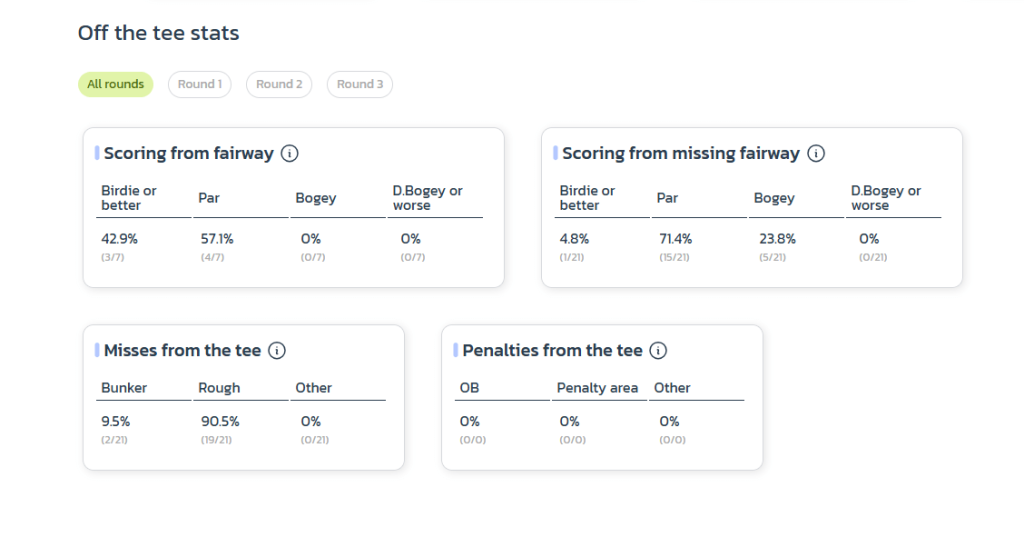
Greens in Regulation (GIR): The Rough complicated it Altopo
GIR statistics were also affected throughout the field. The average of the week was approximately 61%, below the usual for this level of play. More revealing, the players who failed Fairways they were less than 45% of Greens in regulation.
In contrast, those who kept the ball in the Fairway —especially the final contenders— consistently exceeded 70% of GIR, including Marco Penge, who finally won the tournament. In fact, only 11 players in the whole week managed to exceed 70% of Greens, and all finished T25 or better.

Putting: fast, firm and mentally demanding
The Greens They added another layer of difficulty. They were not excessively wavy, but they were fast, firm and subtly treacherous. Even short putts required maximum concentration, and many players had a hard time converting their chances.
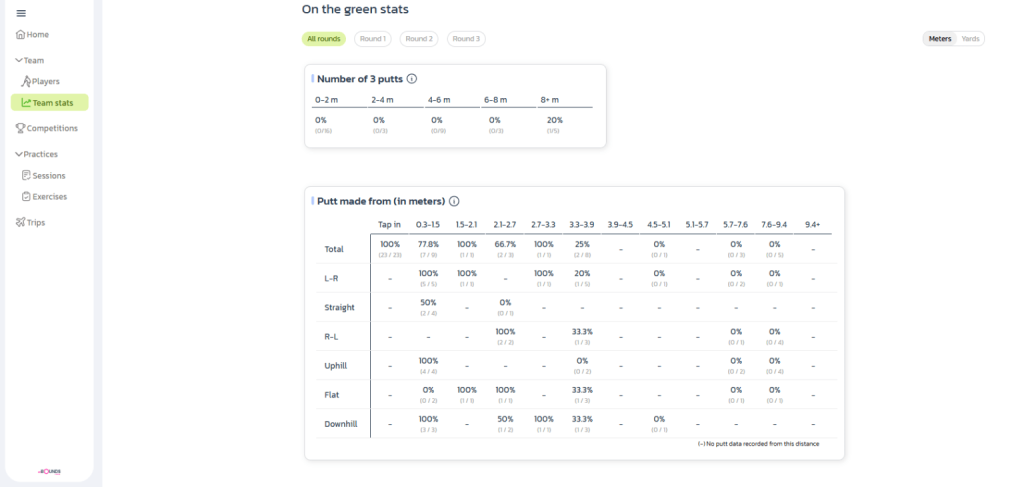
The average putts per round was about 29.8, but the key factor was the Strokes Gained Putting. Players who earned more than +1.5 hits per round in the Greens They had real options to compete. Others, despite hitting the ball well, simply couldn’t keep up.
We observed data showing some players losing more than 2 hits per round in the Greens —Often due to 25–30 feet or a bad reading of fast putts downhill. The field averaged 1.79 putts per GIR and, over four rounds, that gradually drained the performance of many solid laps.
Putts Open Spain Golf 2025
Conclusion: Precision continues to reign in the 2025 Spain Open
At the Villa de Madrid country club, success depended on control and execution, not on brute force. The Fairways narrow, the Rough dense and the Greens Firms exposed every weakness and rewarded players who managed the risk intelligently.
In a sport increasingly obsessed with distance, the Golf Open of Spain 2025 It was a refreshing return to authentic championship golf—where smart play and mental strength define the winner.
Every blow counted, every decision mattered and, at the end of the week, it became clear why precision remains the ultimate skill in golf.
