
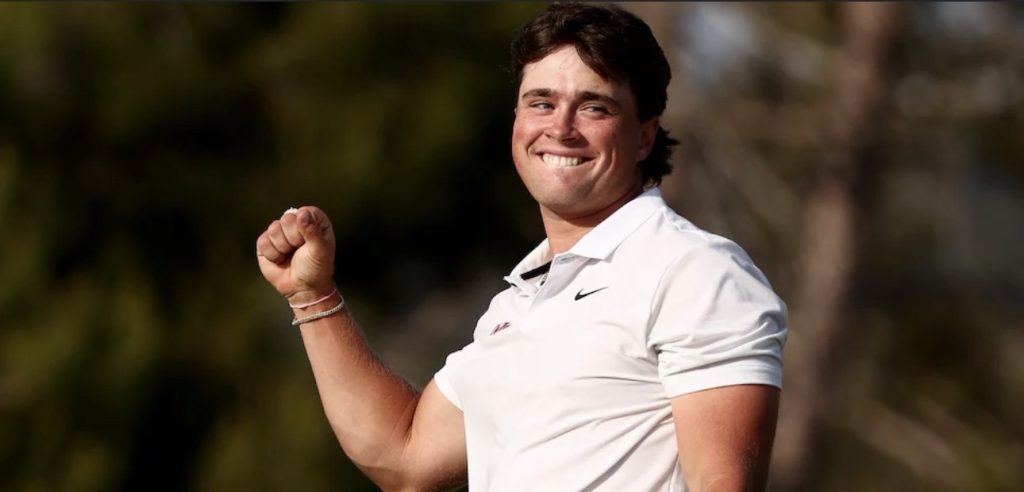
Michael La Sasso’s first professional victory came at one of the most important moments of the 2026 LIV Golf season. At just 22 years old, the former Ole Miss standout won LIV Golf Indianapolis at The Club at Chatham Hills, finishing at 18-under par and one shot ahead of Jon Rahm. The victory made La Sasso the youngest winner in LIV Golf history and capped a remarkable transition from NCAA champion to professional winner. (LIV Golf)
What makes La Sasso’s victory particularly interesting is how quickly he has been able to translate his college game into professional golf. He entered the professional ranks after winning the 2025 NCAA individual championship and joined the HyFlyers for his rookie LIV season. Less than a year later, he was holding his first professional trophy.
His performance in Indianapolis also provides an excellent example of why understanding performance statistics is becoming increasingly important for young players. La Sasso did not win simply because he had one incredible round. He combined an extraordinary scoring performance with consistency across four rounds, creating enough opportunities to withstand a final-round challenge from one of the best players in the world.
For NCAA programs, his development offers an important lesson: as the level of amateur golf continues to rise, helping players understand why they are performing well can be just as important as helping them improve technically.
A 60 That Changed the Tournament
La Sasso opened the tournament with a 1-under 71, which was solid but hardly suggested what was about to happen.
On Friday, everything changed.
He produced a 10-under 60, making 10 birdies and posting the lowest round of his professional career. The round moved him from outside the lead into serious contention and demonstrated the scoring potential that had made him one of the best players in college golf. (hitc.com)
The important part, however, was what happened afterward.
Players can shoot 60 and then struggle to maintain momentum. La Sasso followed his 60 with a 4-under 66, including an eagle and five birdies despite making two bogeys. That put him at 13-under after 54 holes and gave him a one-shot lead heading into the final round. (newstribune.com)
He then closed with a 5-under 65, finishing at 18-under for the tournament and holding off Rahm, who shot 63 in the final round. (LIV Golf)
His four-round progression tells the story:
71 – 60 – 66 – 65 = 262 (-18)
The 60 grabbed the attention, but the 66 and 65 are arguably what won him the tournament. After producing an extraordinary round, La Sasso did not give the tournament back. He continued to produce low scores and maintained control when the pressure increased.
The Statistics Behind the Win
The most obvious statistic from Indianapolis is the 10-under 60.
Ten birdies in one round demonstrates an exceptional ability to create scoring opportunities, but the broader performance is more interesting. La Sasso made 20 birdies and an eagle across 72 holes, giving him an enormous amount of scoring production throughout the week.
His third round was another example of that balance. He made five birdies and an eagle while overcoming two bogeys to shoot 66. Instead of allowing mistakes to derail the round, he immediately compensated for them with scoring opportunities. (newstribune.com)
Then came the final round.
La Sasso closed with a bogey-free 65, which was exactly what he needed against Rahm’s 63. The final round showed that his win wasn’t simply the result of getting hot with the putter for one afternoon. He was able to maintain his decision-making and scoring efficiency when the tournament was on the line. (LIV Golf)
That combination—birdie creation, damage control, and consistency—is particularly valuable for young players transitioning into professional golf.
The NCAA Connection
La Sasso’s development is another example of how powerful the NCAA pathway has become.
Before turning professional, he produced one of the strongest seasons in Ole Miss men’s golf history. During the 2024–25 season, he recorded a 69.48 scoring average, the lowest single-season scoring average in Ole Miss program history, and went on to win the NCAA individual championship. (Wikipedia)
He also competed in major amateur events and represented the United States in competitions including the Arnold Palmer Cup and Walker Cup. By the time he joined LIV Golf, he had already experienced high-pressure competition against many of the world’s best amateurs.
That preparation matters.
The gap between elite NCAA golf and professional golf continues to shrink. We have already seen players such as Jackson Koivun, Michael Thorbjornsen, Tommy Morrison, Derek Hitchner and now La Sasso demonstrate how quickly successful college players can transition into professional winners.
These players are entering professional golf with years of experience competing in elite fields, traveling internationally, preparing for tournaments, working with specialized coaches, and analyzing their performances.
They aren’t starting from zero.
Why Young Players Are Winning So Quickly
One of the biggest reasons young golfers are succeeding earlier is that player development has become much more structured.
The modern college golfer has access to technology, strength and conditioning, sports psychology, launch-monitor data, tournament analytics, and specialized coaching. Programs are able to identify weaknesses earlier and create individualized development plans rather than relying solely on general practice.
This is especially important because talent at the NCAA level is already extremely high.
The difference between a player ranked 20th and a player ranked 100th may not be enormous technically. The difference can come down to decision-making, consistency, approach play, short-game performance, and how effectively they use their practice time.
That is where data becomes important.
Where Inbounds Can Help
Platforms such as INBOUNDS can help NCAA programs turn tournament performance into actionable practice information.
A scorecard tells a player what they shot. A deeper statistical analysis can help explain why.
For example, a player might finish a tournament at 8-under and assume that everything worked well. But the data might show that they gained significant strokes off the tee while losing strokes on approach shots from 150–175 yards.
Another player might shoot the same score but have the opposite profile.
Those two golfers should not have the same practice plan.
INBOUNDS can help coaches and players track these patterns across tournaments, making it easier to identify consistent strengths and weaknesses rather than reacting to one isolated round. That information can then be used to create more targeted practice sessions.
This is particularly valuable in college golf, where teams have limited practice time between tournaments.
Instead of asking a player to “work on the short game” or “hit more wedges,” coaches can make practice more specific based on the areas that are actually affecting scoring.
Teaching Players to Read Their Own Game
Perhaps the biggest benefit of using statistics isn’t the information itself. It is teaching players how to interpret that information.
A college golfer who learns to understand their own statistics becomes more independent.
After a tournament, instead of simply thinking, I played badly, they can ask more useful questions:
Where did I lose strokes?
Which areas were better than my season average?
What mistakes happened repeatedly?
Which part of my game should I prioritize this week?
Did the work I did last week actually improve my tournament performance?
That creates a continuous development cycle:
Compete → Analyze → Practice → Compete Again → Measure
The goal is to make every tournament useful, even when the result isn’t what the player wanted.
The Bigger Lesson From La Sasso
Michael La Sasso’s victory in Indianapolis is impressive because of what happened on Sunday, but his development shows why the story is bigger than one LIV Golf tournament.
He arrived on the professional scene as an NCAA champion with an established track record of producing low scores. He then went through a challenging rookie season before putting everything together in Indianapolis.
That process is important for young players to understand. Data isn’t designed to make development perfect. It is designed to make development more informed.
La Sasso’s 60 grabbed the headlines, but his 66 and 65 showed why he ultimately won. He created an enormous number of scoring opportunities, limited the damage from mistakes, and maintained his performance over the final two rounds while playing alongside players with significantly more professional experience.
For NCAA programs, the lesson is clear. The next generation of professional winners is already being developed on college campuses, and the margins between success and failure are becoming smaller every year.
The programs that combine great coaching with competitive experience and reliable performance data will be better positioned to develop those players.
INBOUNDS can be part of that process by connecting tournament statistics with practice, helping coaches identify where players can improve and teaching athletes to understand their own performance.
Michael La Sasso’s journey from Ole Miss NCAA champion to the youngest winner in LIV Golf history is another example of how quickly elite college golfers can make the transition to professional success. As more young players follow the same path, the ability to understand performance—not just talent—will become an increasingly important advantage in NCAA golf.


How to Build a Golf Practice Routine Based on Your Stats
Most golfers have a practice routine. Fewer have a practice routine that is actually based on what their game needs.
It’s easy to arrive at the range, hit a few drivers, work through the bag and finish with some wedges. You leave feeling like you had a good session. But did you work on the part of your game that is actually costing you strokes?

How to Know If You’re Really Improving at Golf: Learn How to Measure Your Progress
Getting better at golf doesn’t always mean your handicap drops every few weeks. You can be playing better golf while your Handicap Index barely moves. The opposite can happen too: you string together one good round and feel like you’ve made a huge leap, when in reality there’s no real, consistent change in your game yet

How to Lower Your Golf Handicap: train smarter, not just more
Lowering your golf handicap is not simply about playing more rounds or spending more hours on the range. The key is understanding where you are losing strokes, what is affecting your performance and what you should work on next.
