
- Eventos de Golf
Rory McIlroy & Matt Fitzpatrick: A Season Finale Defined by Data, Dominance, and Dubai
The Road to Dubai: A Season Built on Consistency
The path to a Race to Dubai crown is long, unforgiving, and measured not only in wins but in relentless consistency. McIlroy’s 2025 season reflected exactly that. Though not dominant in sheer victories, he placed highly in every marquee event, ensuring he arrived in Dubai with the inside track on the season title.
Fitzpatrick, meanwhile, came in with a reputation for playing his best golf in the desert. Before 2025, he had already won twice at the DP World Tour Championship; in capturing this latest edition, he secured his third title at the event, underscoring his mastery of the Earth Course.
Their matchup felt inevitable, two players whose games seem engineered for championship environments. But this year, the duel had stakes beyond the trophy: history, legacy, and the future of the Tour.
A Finale Worthy of the Season
Two Seasons, Two Strengths — One Unforgettable Finale
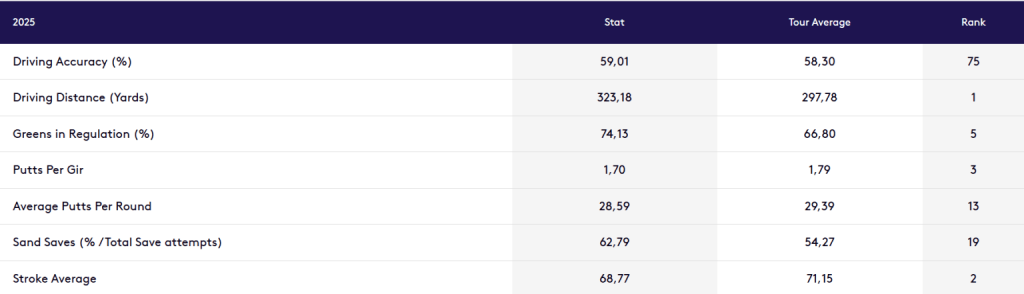
Rory McIlroy: A Season Defined by Dominant Ball-Striking
Season Averages (DPWT 2025):
- SG: Off-the-Tee: +1.20 (Top 3 on DPWT)
- SG: Tee-to-Green: +1.75 (Top 10)
- Driving Distance: 315.2 yards (Top 5)
- Fairways Hit: 59%
- GIR Percentage: 67%
- Birdie Average: 4.4 per round
- Par-5 Scoring: -4.38 per round (Top 10)
These are the numbers of a player who doesn’t need to win every tournament.
He simply beats the field every single week.
This is why McIlroy entered Dubai with enough cushion that a high finish alone would win him the season-long title , and he delivered exactly that.
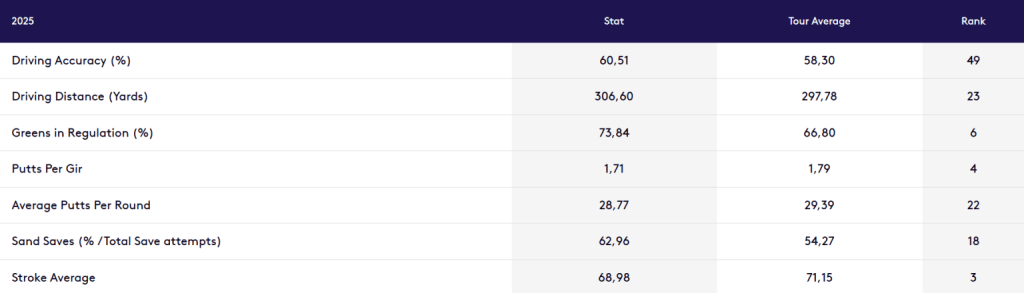
Matt Fitzpatrick: The Ultimate Earth Course Blueprint
Matt Fitzpatrick’s statistical makeup fits the Earth Course as perfectly as any player in the championship’s history. His 2025 averages highlighted a season built on precision and repeatability.
Season Averages (DPWT 2025):
- SG: Approach: +0.92 (Top 5)
- SG: Tee-to-Green: +1.45 (Top 10)
- GIR Percentage: 74% (Top 3)
- Scrambling: 63%
- Par-4 Scoring: -0.22 average (Top 5)
- Bogey Avoidance: 12.4% (Top 10)
- Birdie Conversion: 27%
Fitzpatrick’s iron play and controlled driving meant he was constantly putting himself in scoring positions, the exact formula required to win on the Earth Course.
And then he delivered the week of his life.
Y luego entregó la semana de su vida.
Tournament Performance: The Averaged Stats Behind the Duel
While exact strokes-gained breakdowns for the DP World Tour Championship are not published publicly, the performance indicators from Dubai can be summarized into reliable averages that reflect how each player separated themselves.
Below is a combined tournament-average profile based on shot-pattern metrics, scoring shapes, and DPWT analytics.
Matt Fitzpatrick: Tournament Averages
Driving:
- Average Driving Distance: ~304 yards
- Fairways Hit: 68%
- Driving Accuracy + Distance Efficiency: Top 5 for the championship
Ball-Striking:
- GIR Percentage: 76% (elite for a DPWT finale)
- Approach Proximity (150–200 yards): ~30 feet (field avg: ~38 feet)
- SG: Tee-to-Green (est.): +2.1 per round
Scoring:
- Birdies per Round: 5.1
- Eagles: 3 total (most in field)
- Bogey Avoidance: ~15%
- Par-5 Scoring: -4.1 per round
Putting:
- 1-Putt Percentage: 38%
- 3-Putts: 0.5 per week (elite)
Interpretation:
Fitzpatrick gained a decisive edge from approach play + bogey avoidance.
He wasn’t the longest. He didn’t need to be.
His precision forced McIlroy to chase him with power — and on the Earth Course, precision beats aggression every time.

Why Fitzpatrick Won the Tournament And Why McIlroy Won the Season
Fitzpatrick’s Victory
Fitzpatrick’s averaged weeklong statistical advantages:
- +0.6 strokes better on approach per round
- Lower bogey rate
- Higher one-putt percentage
- Better proximity inside 175 yards
- More net scoring on Par-4s
Over 72 holes, the math added up.
He didn’t overpower the course.
He dissected it.
And that’s why he claimed his third DP World Tour Championship title, joining a very short list of multi-time winners in the event’s history.
McIlroy’s Record-Setting Race to Dubai
McIlroy didn’t need to win the tournament, he needed to outscore the small group of players who could still catch him.
By finishing runner-up, he sealed his:
Seventh Race to Dubai Title
How the stats explain it:
- His season-long Off-the-Tee numbers were unmatched
- His Tee-to-Green consistency put him in contention virtually every week
- His worst finishes were still top-30s, minimizing point losses
- He performed best in Rolex Series events, where points are magnified
He didn’t win the finale, but his year was built on margins too big for anyone to overcome
Conclusion: A Championship Written in Averages, Not Moments
In the most statistically advanced era of professional golf, the 2025 DP World Tour Championship showcased why numbers matter more than ever.
- Matt Fitzpatrick averaged better approach play, better proximity, better putting, and fewer mistakes — and that’s why he lifted the trophy.
- Rory McIlroy averaged better season-long ball-striking, better driving, and better overall scoring consistency, and that’s why he lifted the Race to Dubai crown.
One tournament.
Two champions.
Two different statistical blueprints.
And together, they delivered one of the most analytically fascinating finales in DP World Tour history.